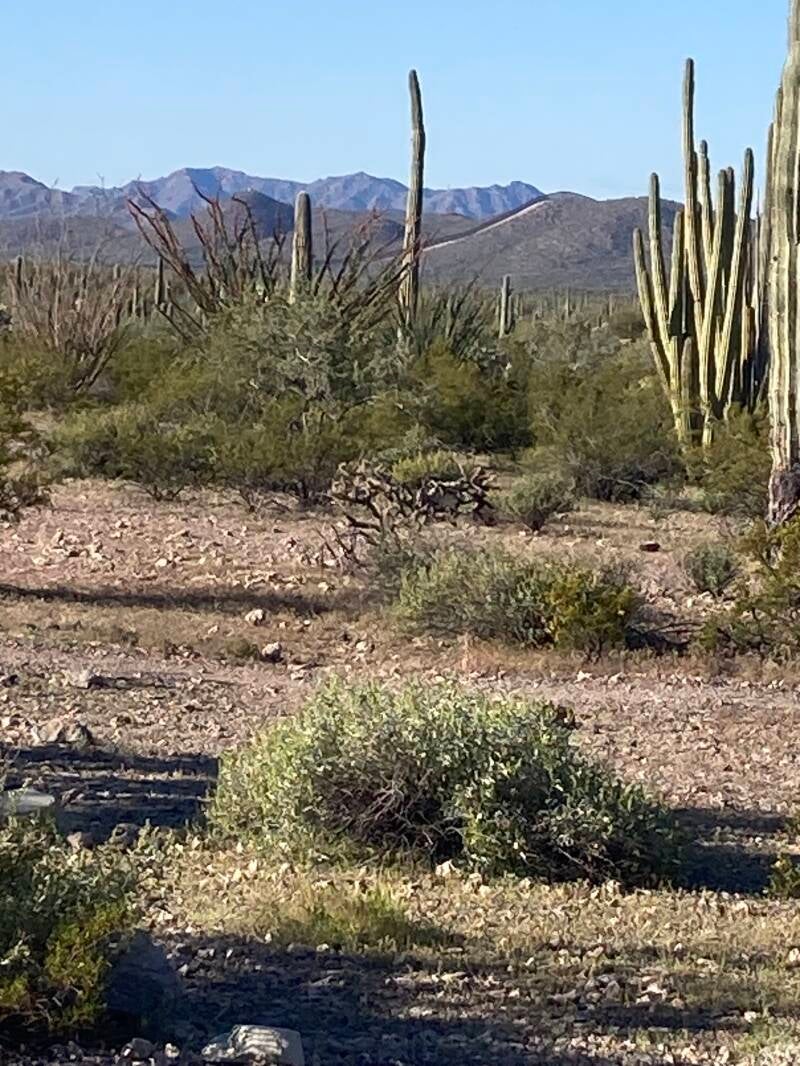
The border between the US and Mexico is about 2 miles away from this campground. You can see the “wall” as it snakes over the hillside in the near distance. At the Ranger Talks, public service announcements remind you to watch out for rattlesnakes and scorpions, always carry more water than you think you'll need, as well as to be careful while out hiking in case you run across illegals, or worse, a body dead from exposure or heat exhaustion. The “wall” and its impact upon local wildlife is mentioned often during lectures. The wall has interrupted habitats all over the place, cutting wildlife off from the nearby Quitobaquito watering hole (the second largest body of water in the Sonoran desert, and really it’s a pond). In particular, the pronghorn antelope have been heavily affected.
At a recent evening talk, the park had a guest speaker who we understood to be a local photographer. We assumed he would be a nature photographer. Instead we were surprised to learn that this fellow had worked for 11 years as a janitor at the nearby border processing center. As he spent time there he became interested in the amount of food (think cans of tuna) that had been confiscated from detainees caught illegally crossing the border. He petitioned to deliver this food to the local food bank. Then he began to notice that the trash was full of personal belongings confiscated from the detainees. Over the years he carried these things home and began a project of photographing the objects in graphic-art arrangements of similar items. For example geometric looking groups of black combs and brushes, groups of white combs and brushes, groups of pink combs and brushes,bottles of cologne, toothbrushes, blankets, candy, toys, etc. The quantity of items that he has brought home and photographed, and then “archived” is phenomenal. He had a big supply of trashed wallets as well. These wallets still contained ID, credit cards, personal letters and photos. I understand that if people are detained, then their belongings are confiscated. However, I don’t understand why, if those people are then deported, their personal belongings are not returned to them. Obviously, their things are confiscated, then thrown away. It was a disturbing talk. The photos made me think of similar pictures of piles of belongings confiscated from Jews and other target groups in WWII concentration camps .